
Standards and limits
Standards and limits
- Sound onlyNo camera, photo, or video. The API refuses them
- Open weightsA pinned, self-hosted sound model for dogs
- AbstentionUnknown when the recording supports nothing
- Words, not scoresConfidence is language, never a percentage
- PrivyOne user-owned embedded wallet per pet, with a revocable signer
- USDCSettlement asset, test USDC on Base Sepolia today
Overview
A phone for the ones
who can’t hold one.
MeowWa gives each pet an agent of its own. It listens through the phone, tells you what it heard, says what that likely means when something supports a reading, and brings you every decision that is yours to make. The pet wallet is one of the tools the agent can reach, bounded like the rest, and no longer the identity of the whole product. The iPhone app comes first, and MeowWa hardware is deferred until the app is proven.
What it hears
It tells you what it heard, and what it does not know.
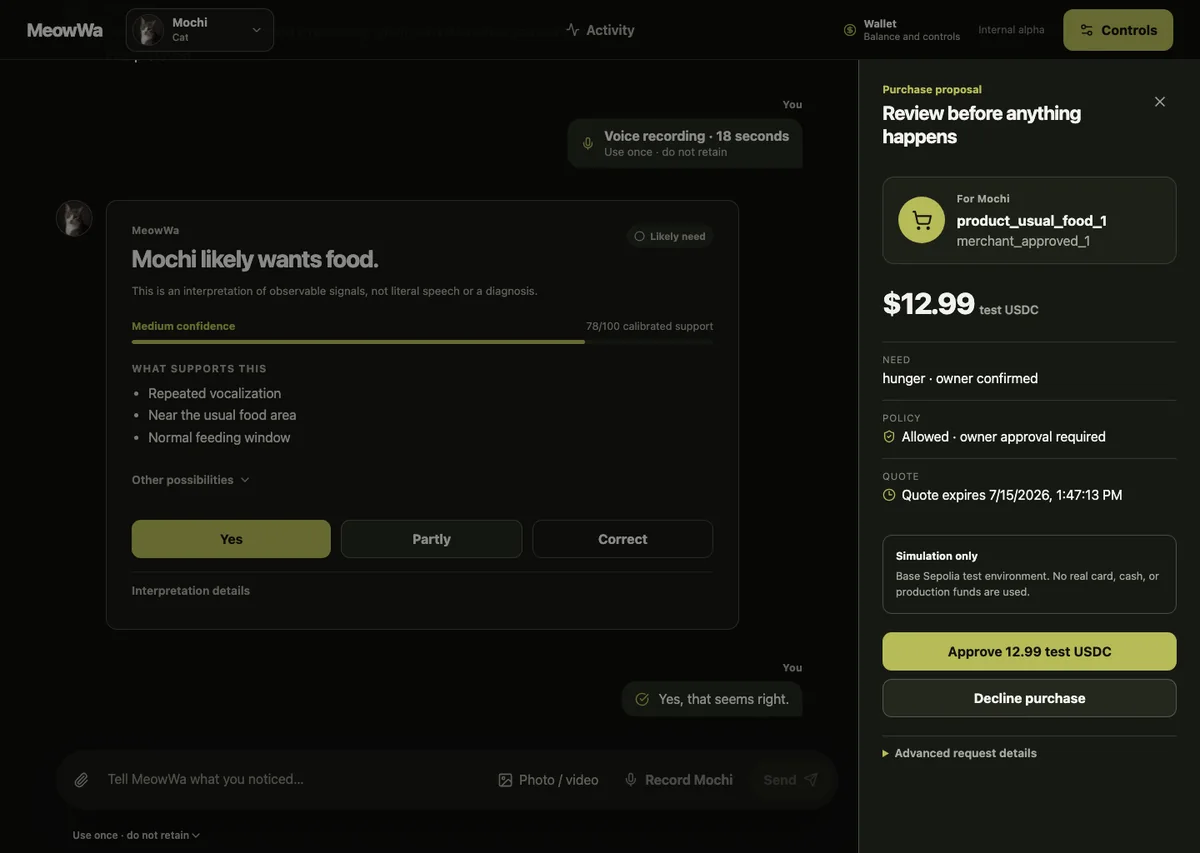
A recording becomes an interpretation, and the interpretation is labelled as one. MeowWa does not claim to translate an animal and does not diagnose anything. Where the sound alone cannot settle a question, the honest answer is the one it gives.
- What it reports
The sounds themselves
For a dog, a pinned open-weight sound model names the vocalizations in the recording: barking, yipping, growling, howling, whimpering. Each one comes with how loud it was next to this pet's own baseline, not next to any other animal.
- What it infers
A likely need, when something supports one
A sound is not a need. The same bark means different things at the door and at the postman, and the difference is not in the audio. MeowWa names a need only when your household has already confirmed that meaning for this pet, or as a first guess that is marked as one and waits for your answer.
- How sure it is
Said in words
Most likely, probably, possibly, not clear. The product does not print a percentage, because nothing has been calibrated well enough for a number to mean anything. A first guess for a pet it has never heard is capped below confident on purpose.
- When it stops
Unknown, and ask again
Silence, a poor recording, or a sound nothing can be read from returns unknown and asks for another one. Anything that reads as discomfort or distress routes you to a veterinarian and can never become a purchase. No cat provider has been selected yet, so cat audio abstains.
Permissions
Nothing happens because a pet made a sound.
A pet never authenticates anything, and a sound is never a password. Between the interpretation and any real action sits a deterministic check that you configured: which pet, which resource, which exact action, inside which limits, until when.
Owner-taught meaning
What a sound means for this pet is something your household teaches, one confirmation at a time. Every entry can be corrected or deleted, memory belongs to one pet and never moves to another, and one uncertain reading never hardens into a fact.
One routine at a time
A routine is one owner, one pet, one taught sound, one action, and one exact resource. It is created on its own and it grants nothing by itself.
Four permission levels
Suggestions only, ask every time, automatic within limits, or a custom setting inside the product's hard bounds. There is no full access, and every new routine starts at ask every time.
Grants that expire
A grant names the pet, the resource, the exact action, its limits, and its expiry. A changed model, policy, or routine suspends it until it is reviewed, and the agent can never grant, widen, or renew its own authority.
Bounded tools
The pet wallet is one tool, and supported devices are planned as another. Each executes one exact action and reports only what it can truthfully verify, including that an outcome is unknown.
Approvals
Every approval arrives as a plain request.
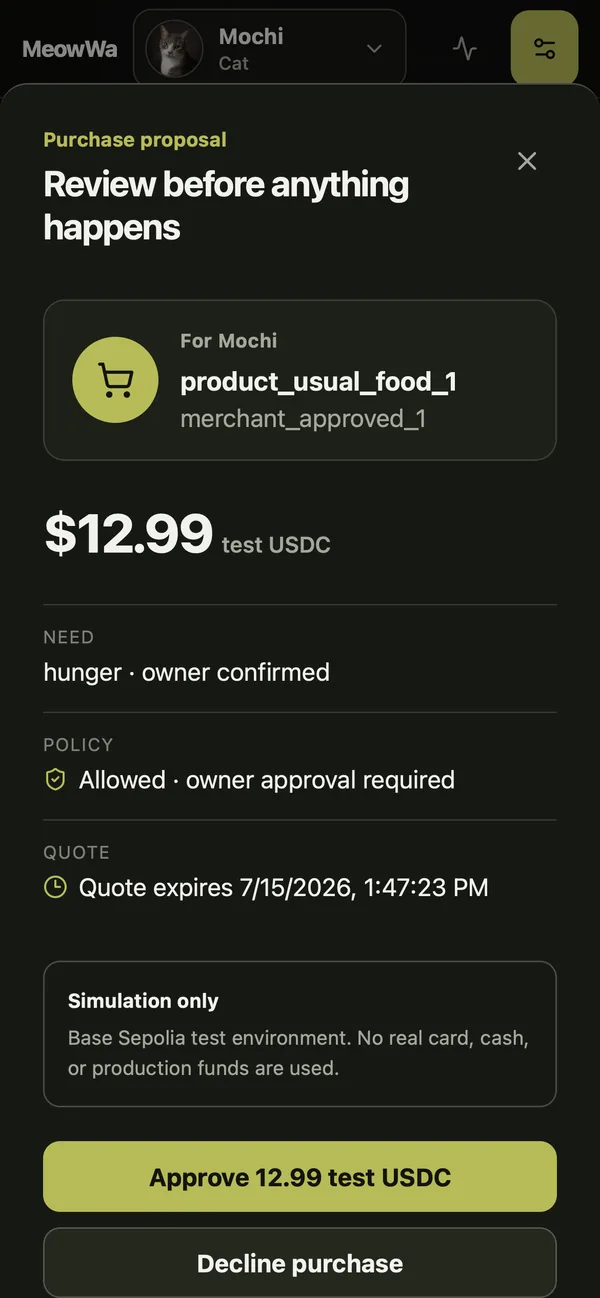
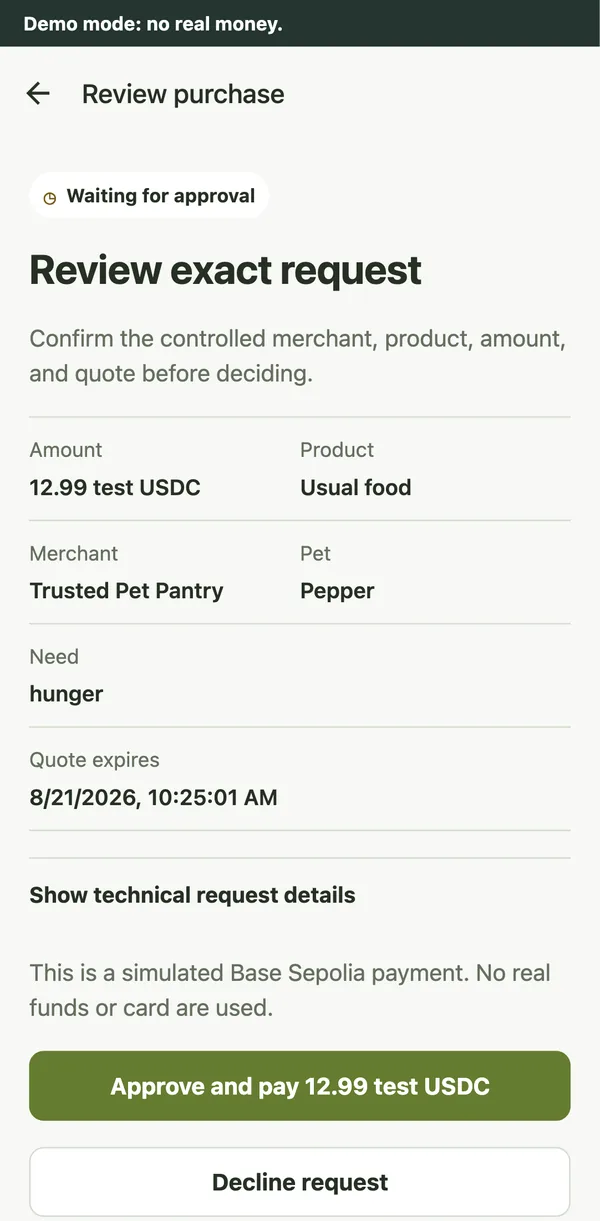
When a purchase needs your decision, the app presents the amount, the merchant, the interpreted need, the policy result, and the quote expiry on one screen. One tap approves it, one tap declines it, and the quote expires on its own if neither happens. Approval and payment stay two separate recorded steps, so approving is not the same as spending.
Where it runs
One agent, on the screens that exist.
A pet’s agent is one identity, one memory, and one set of permissions behind a single API. The iPhone app is the product the platform is being built for; the others came first and are kept honest about what they are.
- The first client
iPhone
The product the platform is being built for. The app compiles, is signed for distribution, and is not yet through TestFlight review, so there is no public build today.
- Invite only
Mac
A signed and notarized Mac app, prepared for an invite-only beta on test funds. It is not a public release.
- Internal alpha
Web
The owner workspace used for internal runs, and the screen shown further up this page.
- One API
API
Every surface reads and writes the same record, so a limit set on one screen binds the others.
How it works
You start it, you correct it, you decide what it may do.
The agent is not running in the background of your home. It listens when you start a session, and the authority it has is the authority you handed it, one routine at a time.
Start a session
You open the app, choose one pet, and start listening. The microphone state stays visible, the session is foreground and online only, and there is no hidden always-listening mode.
Read it and correct it
Messages appear in order as sound moments are interpreted. You can say the reading was right, partly right, or wrong, and you can teach what a recurring sound means for this pet.
Decide what it may do
Anything the agent proposes is checked against your permissions before you see it. Whatever falls outside a current grant waits for your decision and expires on its own if none arrives.
What is proven, and what is not
Not a promise. A receipt.
Status: internal alpha on testnet, using test USDC and a controlled merchant. No real commerce has taken place and no real money has moved on any network. The first three rows carry an address or a transaction from a live run on Base Sepolia, and each one can be checked on Basescan without contacting us. The rest have no hash to show, and they matter just as much: two are enforced in the product, and three are things we have not proven and do not claim.
- Wallet
One wallet per pet
Mochi's own embedded HD wallet: a 1-of-1 owner quorum plus one narrow, revocable agent signer.
0x24ca21b1…b73ea9caView One wallet per pet on Basescan, opens in a new tab - Purchase
The agent paid a merchant, once
6.99 test USDC paid to a controlled merchant after owner approval, on 19 July 2026. Settled once, with no replay, and gas paid in test USDC. This was a deliberate one-off run against the real wallet boundary; the purchase step inside the app is a labelled simulation by default.
0x3c7e6da7…0f28846fView The agent paid a merchant, once on Basescan, opens in a new tab - Refund
The merchant refunded the wallet
The exact amount returned to Mochi's wallet. Twelve confirmations, reconciled once, with no duplicate credit.
0xf765d519…5c396865View The merchant refunded the wallet on Basescan, opens in a new tab - Execution
A plain transfer, not a bespoke escrow
The purchase above is an ordinary USDC transfer submitted through Privy from the pet's own embedded wallet, under a narrow, revocable agent signer. Spending authority is a permission, not a shared key. There is no smart account, bundler, or paymaster of ours in the middle, and an audited account abstraction setup is intended for production rather than running today.
Privy - Enforced in policy
Revocation fails closed
Pausing the wallet or revoking the signer blocks both authorization and execution. No pending request survives it.
Fail-closed - Not claimed
No accuracy number for pet needs
No reviewed dataset yet meets our consent, provenance, and held-out requirements, so there is no accuracy, precision, or calibration figure for what a sound means, and we do not publish one. Our own earlier candidate was measured and rejected.
Not claimed - Off by default
Interpretation ships disabled
The checked-in configuration disables the AI release state, so a production deployment refuses evidence and creates no interpretation at all. It is turned on for internal runs, behind an explicitly labelled simulator in development.
Disabled - Built, not on
Solana is a rail, not a claim
Funding, deposits, and withdrawals are written for Solana beside Base, and the switch defaults to Base alone, so nothing runs on Solana today. Agent execution has no Solana path at all. We will say it is live when a transaction proves it.
Switched off
Contact
Book a demo, or join the waitlist.
MeowWa is an internal alpha. Leave an email to join the waitlist, and add a message to book a walkthrough of the listening session, the permission model, or the wallet policy and its on-chain receipts. Spots open in small batches.